 FEDELCO, S.L.
FEDELCO, S.L.
C/ Lago Constanza, 46
28017 Madrid
Tel: 91 408 16 25
Fax: 91 408 16 90
10:00 - 13:30 horas
14:30 - 17:30 horas
de lunes a viernes.
MATERIAL DE MICROSCOPIA ELECTRÓNICA
TIPOS DE REJILLAS GILDER

Comprising of 13 ypes with mesh repeat values ranging from 50 lines/inch to 600 lines/inch. The overall thickness of the grid depends on the mesh repeat, and as a general guide the lower the mesh repeat, the thicker the grid. The variation in thickness and bar/hole width in a population of 100 grids (1 vial) again increases with a lower mesh repeat.
Overall thickness variation :
• G50 : 25 microns, +/- 5 microns
• G600TT : 6 microns, +/- 2 microns

As an alternative to square mesh, hexagonal mesh grids offer a higher support factor for a given mesh repeat distance.
Overall thickness variation :
• G50HEX : 25 microns, +/- 5 microns
• G400HEX : 10 microns, +/- 2 microns

14 types offer a wide choice of specimen support. Parallel bar grids are
particularly useful for obtaining information from sequential ribbons of sections.
Overall thickness variation :
• G50P/PB : 27 microns, +/- 5 microns
• G400P/PB : 12microns, +/- 2 microns

Comprising of 2 types, offering a different pattern of support.

Comprising of 6 different types, offering a wide choice of slot options for film support. The larger the slot dimensions, the thicker the grids, for maximum rigidity.
Overall thickness variation :
• G1X0.2 : 25 microns, +/- 3 microns
• G2X1.5 : 60 microns, +/- 6 microns

Comprising of 10 types, Aperture grids consist of one central circular hole. The larger the aperture dimension, the thicker the grid, for maximum rigidity.
Overall thickness variation :
• GA75 : 25 microns, +/- 3 microns
• GA2000 : 50 microns, +/- 5 microns

The 'HS' series are a development from the earlier 'HH' ultra-high transmission grids. They offer an alternative to the standard square mesh grid for use in applications where it is important that the maximum area of specimen is available for viewing in the microscope.
The open area of a G200HS is 40% greater than that of a standard G200

The 'HH' series offers a very high transmission value with the additional support of a hexagonal pattern. They offer an alternative to the standard hexagonal mesh grids for use in applications where it is important that the maximum area of specimen is available for viewing in the microscope.

The Finder range of grids are useful in applications where specific areas of mesh need to be uniquely identified. These areas range from blocks of 1 to 9 grid cells, and can typically be relocated using an alphabetical and/or numerical code built into the mesh.

Double grids, offering a combination of mesh support values, are used primarily in metallurgical applications for supporting thin metal foils. Two grids are joined by a thin 'hinge', allowing one grid to be folded on top of the other, trapping the specimen between them. The grids have a curved securing tab which folds to the curvature of the doubled grid.
PORTARREJILLAS
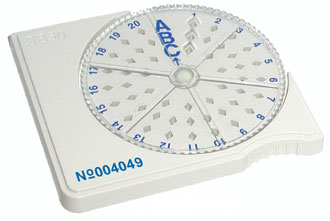
The SB50 grid storage box is designed for the routine handling and long term storage of 50 standard size TEM grids. This new ergonomic design incorporates several features that overcome the disadvantages associated with storage boxes of the more conventional ‘sliding cover’ design. The SB50BN has a unique number on the face and one end.
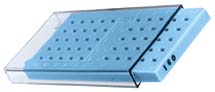
Grid Storage Boxes style 160 Standard and style 161. Tabbed may be ordered consecutively numbered. Numbers are permanently stamped into the end as shown. 100 piece minimum for numbering (except when ordering Storage
System No. 160-15).< br />
Choosing Your Numbers: Use
No. 160-7 or 161-7 when ordering a 1-100 numbered set and use No. 160-9 or 161-9 for a special number sequence. Note: special numbering sequence sets are limited to four digits and are non-returnable.
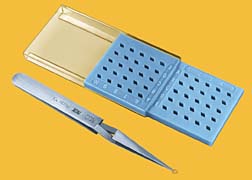
A smoothly sliding clear plastic cover is matched to a tough, clean, self-lubricating base. The diamond-shaped grid compartments are designed to minimize awkward wrist or hand movements. The depth of the holes restricts grid movement when transported. Prices are given on an "each" basis, with quantity price breaks.
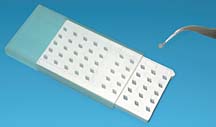
Holds up to 50 tabbed transmission electron microscopy grids in alphanumeric labeled compartments. The box is similar to our catalog number 160 except that the body is made deeper to accommodate the extra length necessary when PELCO® Tabbed Grids are used.
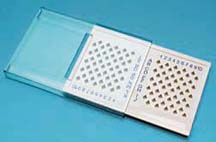
Intended for use in both routine grid handling and long term grid storage. Holds 100 transmission electron microscopy grids. Each of the diamond shaped compartments will accept a 3mm grid. Each position has a letter and number molded into the surface of the box. To further ease grid handling, the plastics are anti-static treated. A central access position in the lid reduces the number of grids exposed when selecting any particular grid.
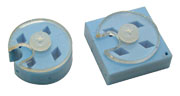
The Cryo Grid Boxes are used for transferring or storing vitrified cryo TEM specimens (i.e. on Quantifoil TEM grids) made with cryo-devices like the Cryoplunge or Vitrobot. They each have 4 storage positions and include a non-static lid which can be rotated. The round Cryo TEM Grid Box fits Gatan 626 Cryotransfer and can be used on the Gatan CT3500 Cryotrans.
The square Cryo TEM Grid Box fits the CT3500 Cryotrans.
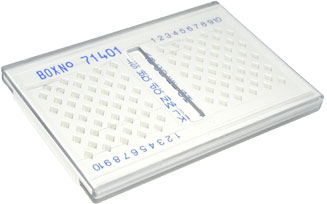
The box holds 100 grids. Each of the diamond shaped 'pockets' will accept either a 2.3 of 3.05mm grid. Once stored the grid is relocated by its 'map reference'. Each position has a blue printed letter and number. Blue is chosen for its visibility under normal 'safelight' conditions. The reference and a brief specimen description are entered on the grid
record card for that box.
The box and lid are precision injection molded from plastics chosen for their smooth sliding action. To further ease grid handling, the plastics are anti-static treated. A central access position in the lid reduces the number of grids exposed when selecting any particular grid.
Para información adicional de nuestros equipos, accesorios o productos llámenos al 91 408 16 25
o enviarnos un e-mail a :